Showing posts with label clay. Show all posts

Monday, February 9, 2015

Is Your Bowl Empty or Full?

Throughout the year, many of you probably get so many requests: to donate an item for a gift basket, an auction, a charity event or Fundraiser. Of course, we are not in business to give away everything we make, but often, a cause will speak to our hearts and we feel impelled to give.

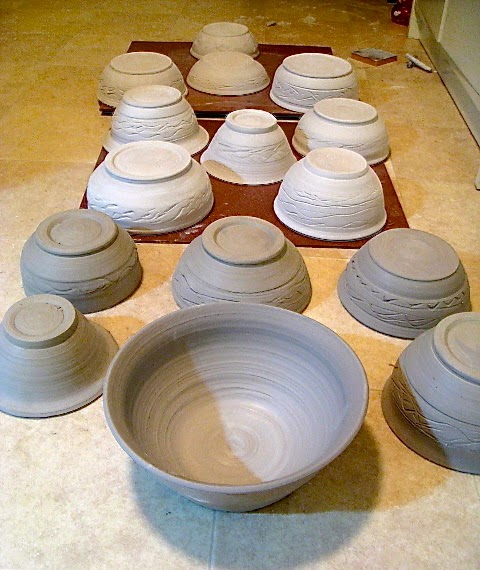
There is a nationwide organization Empty Bowls through which potters across the country make bowls and then sell them at events to raise money for the hungry in their communities. Sometimes the bowls come with soup (for a $10 or $15 donation). Sometimes they are sold through Silent Auction. Some events have performances and music; others are quieter affairs.

When you are an artisan and do much of your work isolated in your studio, it’s so easy to get tunnel vision. But if we have a gift and a passion and can afford to do so, I believe there is nothing as rewarding as giving back to the community that sustains you.

I’ve been a part of Empty Bowls in Warwick, NY for the last several years, and when the date for this year’s event was announced, I was already feeling on overload from having committed to so many other things, and trying to keep up with stocking the stores I am in, getting ready for shows, updating my Etsy site….writing blogs…you know, the familiar gamut.

Yet there was no question in my mind that I had to make time to start making bowls because the effect of “giving” in my experience has always been life giving. It sustains me, it cleanses my soul, it makes me happy. So if there is an organization that speaks to you and makes your heart leap a little, I encourage you to make the time to get involved. I promise you that the energy you will get will be immeasurably more than you expend and will spark your creative juices in new ways.

Roberta - RG Clay Creations

Wednesday, June 11, 2014

Open House at L & M Studio Saturday!

Meg and Lucie from L&M Studio have a new studio in Catskill and you are all invited to check it out!

 L&M Studio
462 Main Street
Catskill, NY 12414

This Saturday from 4:00 to 8:00 pm come check out their new space and work.  There will be refreshments, live music and of course hand-made porcelain items for the home and garden! 

Sunday, December 15, 2013

The Life Of A Potter

This year’s show schedule was filled with disappointing sales and weather.  I did many explorations of other shows and interviewed as many artisans as I could.  There were mixed reviews which resulted in a not very clear idea of what I was experiencing.


The winter is the time I can work without deadlines except the ones self imposed.  I like that a lot.  I get to experiment, amass product and plan for the next season.  I have been firing year round with others that join me at the kiln.  The wood kiln has been put to bed until March or April. 

The pottery conference (NCECA) National Council of Educators in the Ceramic Arts provides much inspiration which lasts more than the mind can conjure.  It is held yearly.  This year it is in Milwaukee.  The conference is usually 3 or 4 days with the host city opening its galleries to pottery, sculpture and ‘all things clay’.  I can’t wait.  My friend Ken Bichell, a potter from Iowa, will be hosting a week long wood fire workshop the week before the conference.  I will definitely be there.


Hope you all have the Happiest of Holidays.  Good friends, good food, good work for the New Year.

Monday, October 28, 2013

Scene’s From The Life Of A Potter

Ever wondered what the life of a Potter was like? Today we show you a glimpse inside the life of Lynn Isaacson from New Prospect Pottery.


Firing the gas kiln at New Prospect Pottery is usually a group effort. Potters from the tri-state area come to the pottery and use the pottery's glazes which are mixed by me. People come early as it takes a bit of time to individually glaze and prepare pots for the kiln. Each potter must wax the bottom of their pots so as not to have them stick to the kiln shelves. Each pot must then be wiped clean of any glaze that adheres to the wax.


It seems like a daunting task to place everyone's pots in the places in the kiln that create the effects each potter prefers. This kiln holds about 80 pots. Some firings have many more pots that will fit into the kiln. It is necessary then to hold two firings back to back. I start loading the kiln as soon as most of the work is glazed. Each potter can help with the loading process. Once loaded, the kiln is sealed so none of the spaces between the door, brick and spy holes contribute to extra air being introduced into the reduction atmosphere. I begin candling the kiln at 3 AM. This process removes any moisture from the pots, kiln furniture such as shelving and shelf supports.

After about an hour and a half of candling with one burner, I light another. An hour after that all four burners are lit. The firing then begins. At approximately 9:30 or 10:00 I put the kiln into what is called 'body reduction'. This deprives the atmosphere in the kiln of oxygen. The flame seeks oxygen from the glazes and the clay. This gives the ware an unreproduceable effect that is different in each area of each specific pot. It is always a surprise to see what comes out after the 36 hour cooling.


Just another day in the life of a potter.

Lynn - newprospectpottery.etsy.com

Monday, July 8, 2013

DIY Leaf Pincushion Pins

 Leaf Pincushion Pins Tutorial

For all you crafters who sew, or know someone who sews, here's a little way to green up your pincushions!

Materials:

Sculpey
x-acto blade or even a toothpick will do
foil
flat top pins or needles from the dollar store


Choose or make various shades of green by mixing the ready made colors with white or clear sculpey.  Just knead the two shades together until blended.  Roll into a tube, and cut some slices.


Make a leaf shape of a slice by rolling it into a ball, flattening it, and pinching one end.  Push in the pin or needle, and push the clay back onto the puncture so it's sealed.  Its nice to have decorative pin heads that are flat, as they are easier on the fingers and okay to iron over.


Gently press the x-acto blade or toothpick onto the top of the sculpey to make the veins of the leaf.


I got some leather punch tools to press into my sculpey pins as well!


 Place or even make the pins right on top of a small piece aluminum foil.  That way you don't even have to move them after you've formed them, which usually distorts their sides.  Bake at 275 degrees for 10 minutes and they are done!  So simple and fun!

Easter Egg by Vanessa of the Pudgy Rabbit
The Garden Party Tortoise goes on his way to new projects


Jody
www.astudiobythesea.etsy.com

Friday, July 23, 2010

What’s In a Foot?

By Noelle from Moonfire Studio

As a potter I find that most people view a vase, plate, cup, etc. as a whole, looking at the form of the piece and the colors of the glaze but don’t look at the bottom or foot of the piece. Believe it or not, the foot is one of the most important parts of a pot. A lot of thought and planning go into the foot.

First one must decide functionally and aesthetically whether to have a formed foot or not. (“Form follows function” is a potter’s mantra.) Then if one does plan to have a foot there is a proscribed method to create said foot. You have to throw the base of the pot thick enough to carve the foot while trimming later on while the clay is leather hard. Also the form the bottom of the pot takes is important to the piece as a whole. For instance, a bowl should be rounded on the bottom following the inside curve of the pot with the foot seemingly placed on the bottom for stability. *insert pictures* Whereas a mug, plate or other form can have a flat bottom with the foot protruding from the bottom. I happen to really like the look of a foot. This created a quandary for several reasons.

In my life I continually strive to reduce my environmental impact – I grow my own food, keep hens for eggs, I reuse and recycle everything that I can, use LED light bulbs, my electricity is 100% wind power, etc. So it follows that in my work as a potter I try to be just as conscious. I fire to cone 6 oxidation (electric) because it saves energy and uses wind power. I am very careful what chemicals I use for glazes. I also reuse every scrap of clay that I can, which brings me back to the foot.

Clay trimmings are annoying; they fly everywhere and make a mess adding dust in the studio, which is a health hazard. They are also drier than the other clay that I save and reuse, which makes it more difficult to recycle without alot of work or a (very expensive) special machine which I don’t have. Trimming also adds another step (well 2 really if you count cleaning up) to a long process and as a mother I don’t have all that much excess time. Over the years I decided to use a method that my first teacher used with great success and showed me. It is not easy. I make the foot as I throw the pot rather than trimming it in afterwards. I have to think of the foot before I even begin to throw the pot so I can leave just the right amount of clay at the bottom of the walls to create the foot. I throw with as little water as possible so that the clay doesn’t become too wet to support the walls; I also have to be very sure to compress the bottom of the pot so it doesn’t develop an S crack later on. I have found that if I make the foot before the final shaping of the piece I can get a much more pleasing shape for the final form. *insert picture* I have been working at this for many years and I can finally say that I am happy with the result even though it isn’t done as it “should” be. There is no wasted clay; less dust; I save time; my pieces aren’t too heavy (most of the time); they look good; and as an added bonus the ring created under the pot looks great with a little glaze.


I hope that I have been able to share a little insight into my foot.